Your Shirdi SaiBaba

Translate if necessary
Shirdi SaiBaba Answers...
Think of your problem...Ask Baba a No. bet'n 1 - 720...
a Number comes to your mind...
That Number = Sai Baba's Answer...
Shirdi Sai Baba Helps Always... in All Ways..
Saibaba Answers
The Miracle here is that Shirdi Sai Baba will answer your questions...
You can ask him for the solution to any of your problem and seek his guidance to proceed further.
Shirdi SaiBaba gives the answer in crisp and clear terms, and to the point..
How it Works..
Assume you are sitting in front of Sri SaiBaba & Baba is smiling at you- Think of your Problem to be solved & Seek Baba's Help.
- Ask him to suggest you any one Number between 1 to 720 as Answer
- A Number will come up in your Mind
- Type that Number in the Answer box above and Press "Ask Baba" button
- That Number = Shirdi Sai Baba's Answer..
- The Number should be between 1 to 720 only...
- The Answer comes up in the next page... where Shirdi Baba gives Crisp & Clear answer.
Yes.. it works like a Miracle
The answers given by him and programmed into a numbering format for the Numbers between 1 to 720.
The answers given here are not ours & are not random either. Each Number has different meanings & solutions and only the answer most suitable to you shall come up in your mind... as the number to the answer. (the first number that comes to your mind) Please don't treat this as child's play, if you believe him.. you will experience the Solution to your Problem.
Millions Have benefited from this...
SaiBaba Miracle... Baba has helped millions of people by answering their question in this web site.
For your Desires Contact SaiBaba Directly...
Shirdi SaiBaba remains a popular saint and is worshipped mainly in Maharashtra, Andhra Pradesh, Gujarat, Karnataka and of course world over. Debate on his Hindu or Muslim origins continues to take place. He is also revered by several notable Hindu and Sufi religious leaders. Some of his disciples received fame as spiritual figures and saints.
Sri SaiBaba left his physical body in October 15, 1918.... but he is believed to be with us even more now than he was earlier...Shirdi Sai baba's Background
Although SaiBaba's origins are unknown, some indications exist that suggest that he was born not far from Shirdi.
Historical researches into genealogies in Shirdi give support to the theory that Baba could have been born with the name Haribhau Bhusari. SaiBaba was notorious for giving vague, misleading and contradictory replies to questions concerning his parentage and origins, brusquely stating the information was unimportant.
He had reportedly stated to a close follower, Mhalsapati, that he has been born of Brahmin parents in the village of Pathri and had been entrusted into the care of a fakir in his infancy. On another occasion, Baba reportedly said that the fakir's wife had left him in the care of a Hindu guru, Venkusa of Selu, and that he had stayed with Venkusa for twelve years as his disciple. This dichotomy has given rise to two major theories regarding SaiBaba's background, with the majority of writers supporting the Hindu background over the Islamic, while others combine both the theories (that Sai Baba was first brought up by a fakir and then by a guru).
SaiBaba reportedly arrived at the village of Shirdi in the Ahmednagar district of Maharashtra, India, when he was about sixteen years old.
Although there is no agreement among biographers about the date of this event, it is generally accepted that SaiBaba stayed in Shirdi for three years, disappeared for a year and returned permanently around 1858, which posits a possible birthyear of 1838.] He led an ascetic life, sitting motionless under a neem tree and meditating while sitting in an asana.
The Sai Satcharita recounts the reaction of the villagers: "The people of the village were wonder-struck to see such a young lad practicing hard penance, not minding heat or cold. By day he associated with no one, by night he was afraid of nobody."
His presence attracted the curiosity of the villagers and the religiously-inclined such as Mhalsapati, Appa Jogle and Kashinatha regularly visited him, while others such as the village children considered him mad and threw stones at him. After some time he left the village, and it is unknown where he stayed at that time or what happened to him.
However, there are some indications that he met with many saints and fakirs, and worked as a weaver; he claimed to have fought with the army of Rani Lakshmibai of Jhansi during the Indian Rebellion of 1857.
Ask a Question to Shirdi Sai Baba
Shirdi Saibaba Settled in Shirdi
In 1858 SaiBaba returned to Shirdi with Chand Patil's wedding procession. After alighting near the Khandoba temple he was greeted with the words "Ya Sai" (welcome saint) by the temple priest Mhalsapati. The name Sai stuck to him and some time later he started being known as SaiBaba. It was around this time that Baba adopted his famous style of dress, consisting of a knee-length one-piece robe (kafni) and a cloth cap. Ramgir Bua, a devotee, testified that SaiBaba was dressed like an athlete and sported 'long hair flowing down to his buttocks' when he arrived in Shirdi, and that he never had his head shaved. It was only after SaiBaba forfeited a wrestling match with one Mohdin Tamboli did he take the kafni and cloth cap, articles of typically Sufi clothing.
This attire contributed to SaiBaba's identification as a Muslim fakir, and was a reason for initial indifference 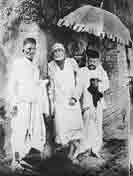 and hostility against him in a predominantly Hindu village. According to B.V. Narasimhaswami, a posthumous follower who was widely praised as Sai Baba's "apostle", recorded that this attitude was prevalent even among some of his devotees in Shirdi even up to 1954.
For four to five years SaiBaba lived under a neem tree, and often wandered for long periods in the jungle in and around Shirdi. His manner was said to be withdrawn and uncommunicative as he undertook long periods of meditation.
He was eventually persuaded to take up residence in an old and dilapidated masjid and lived a solitary life there, surviving by begging for alms and receiving itinerant Hindu or Muslim visitors. In the mosque he maintained a sacred fire which is referred to as a dhuni, from which he had the custom of giving sacred ash ('Udhi') to his guests before they left and which was believed to have healing powers and protection from dangerous situations.
At first he performed the function of a local hakim and treated the sick by application of Udhi. SaiBaba also delivered spiritual teachings to his visitors, recommending the reading of sacred Hindu texts along with the Qur'an, especially insisting on the indispensability of the unbroken remembrance of God's name (dhikr, japa). He often expressed himself in a cryptic manner with the use of parables, symbols and allegories. He participated in religious festivals and was also in the habit of preparing food for his visitors, which he distributed to them as prasad. SaiBaba's entertainment was dancing and singing religious songs (he enjoyed the songs of Kabir most).
His behaviour was sometimes uncouth and violent.
After 1910 SaiBaba's fame began to spread in Mumbai. Numerous people started visiting him, because they regarded him as a saint (or even an avatar) with the power of performing miracles.
Sai Baba took Mahasamadhi on October 15, 1918 at 2.30pm. He died on the lap of one of his devotees with hardly any belongings, and was buried in the "Buty Wada" according to his wish.
Later a mandir was built there known as the "Samadhi Mandir".
Teachings and practices of Shirdi Saibaba
In his personal practice, SaiBaba observed worship procedures belonging to Hinduism and Islam; he shunned any kind of regular rituals but allowed the practice of namaz, chanting of Al-Fatiha, and Qur'an readings at Muslim festival times. Occasionally reciting the Al-Fatiha himself, SaiBaba also enjoyed listening to moulu and qawwali accompanied with the tabla and sarangi twice daily. He also wore clothing reminiscent of a Sufi fakir. SaiBaba also opposed all sorts of persecutions on religious or caste background. (In India at the times when he lived religious intolerance and conflicts were common).
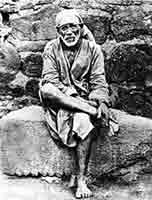 SaiBaba of Shirdi was also an opponent of religious orthodoxy - both Hindu and Muslim. Although SaiBaba himself led the life of an ascetic, he advised his followers to lead an ordinary family life.
SaiBaba encouraged his devotees to pray, chant God's name and read holy scriptures - he told Muslims to study the Qur'an and Hindus texts like the Ramayana, Vishnu Sahasranam, Bhagavad Gita (and commentaries to it), Yoga Vasistha. He advised his devotees and followers to lead a moral life, help others, treat them with love and develop two important features of character: faith (Shraddha) and patience (Saburi). He also criticized atheism. In his teachings SaiBaba emphasised the importance of performing one's duties without attachment to earthly matters and being ever content regardless of the situation.
SaiBaba also interpreted the religious texts of both faiths. According to what the people who stayed with him said and wrote he had a profound knowledge of them. He explained the meaning of the Hindu scriptures in the spirit of Advaita Vedanta. This was the character of his philosophy. It also had numerous elements of bhakti. The three main Hindu spiritual paths - Bhakti Yoga, Jnana Yoga and Karma Yoga - were visible in the teachings of SaiBaba.
Another example of the way he combined both faiths is the Hindu name he gave to his mosque, Dwarakamai.
SaiBaba said that God penetrates everything and lives in every being, and as well that God is the essence of each of them. He emphasised the complete oneness of God which was very close to the Islamic tawhid and the Hindu doctrine, e.g. of the Upanishads. SaiBaba said that the world and all that the human may give is transient and only God and his gifts are eternal. SaiBaba also emphasised the importance of devotion to God - bhakti - and surrender to his will. He also talked about the need of faith and devotion to one's spiritual preceptor (guru).
He said that everyone was the soul and not the body. He advised his disciples and followers to overcome the negative features of character and develop the good ones. He taught them that all fate was determined by karma.
SaiBaba left no written works. His teachings were oral, typically short, pithy sayings rather than elaborate discourses. SaiBaba would ask his followers for money (dakshina), which he would give away to the poor and other devotees the same day and spend the rest on matches. According to his followers he did it in order to rid them of greed and material attachment.
SaiBaba encouraged charity and the importance of sharing with others. He said: "Unless there is some relationship or connection, nobody goes anywhere. If any men or creatures come to you, do not discourteously drive them away, but receive them well and treat them with due respect. Shri Hari (God) will be certainly pleased if you give water to the thirsty, bread to the hungry, clothes to the naked and your verandah to strangers for sitting and resting. If anybody wants any money from you and you are not inclined to give, do not give, but do not bark at him like a dog."
Other favourite sayings of his were:
"Why do you fear when I am here",
"He has no beginning... He has no end",
- Whosoever puts their feet on Shirdi soil, their sufferings will come to an end.
- The wretched and miserable will rise to joy and happiness as soon as they climb the steps of my Samadhi.
- I shall be ever active and vigorous even after leaving this earthly body.
- My tomb shall bless and speak to the needs of my devotees.
- I shall be active and vigorous even from my tomb.
- My mortal remains will speak from my tomb.
- I am ever living to help and guide all who come to me, who surrender to me and who seek refuge in me.
- If you look to me, I look to you.
- If you cast your burden on me, I shall surely bear it.
- If you seek my advice and help, it shall be given to you at once.
- There shall be no want in the house of my devotee.